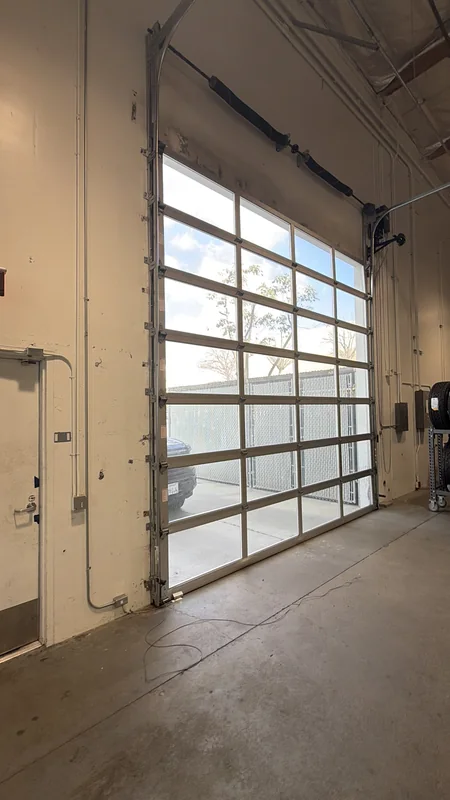
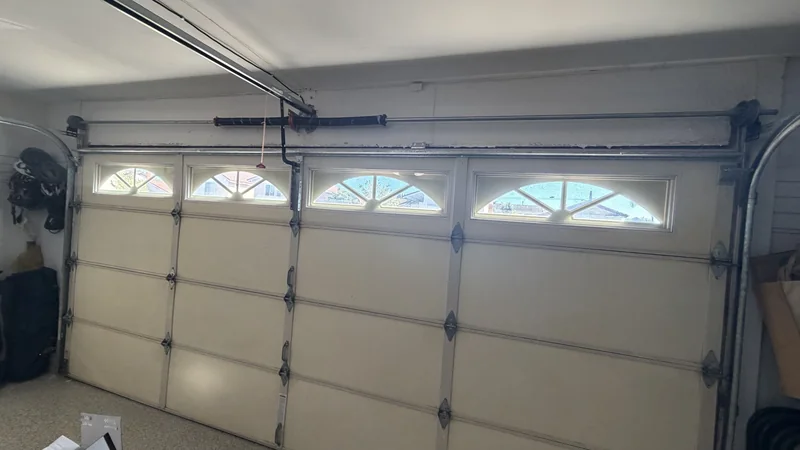
Think of the two lift cables as the straps that keep the door level. One climbs each side. If either lets go, that side drops, and every other part of the door starts pulling at an angle.
What a cable failure looks like from the floor
- The bottom edge rests on the floor at one corner and leaves a wedge of daylight at the other
- A thin steel line lying slack on the concrete, or looping out beside a track
- A drum at one top corner with its cable half unwound or riding outside the grooves
- Loose strands poking out near a bottom corner, like a rope coming apart
- Orange or brown rust where the cable hooks onto the bottom bracket
A door that shudders or thumps on its way up can also be a cable wrapping unevenly. That one is easy to miss.
Cables rarely fail without some warning. In the weeks before one lets go, the door may start rising with one corner an inch ahead of the other, or the bottom edge may stop meeting the floor evenly when it closes. If you spot that, stop using the opener and have it looked at. A frayed cable replaced on a quiet afternoon is a far easier job than a door hanging from one side.
Where cables wear out first
On most doors, the weak spot is the bottom end. The cable loops onto a bracket a few inches off the concrete, right where water gathers. In a Fairlawn garage, that water is meltwater off cars that spent the day on salted roads like West Market Street or I-77. The brine sits against the bracket and the braided steel for weeks at a stretch, and rust works in from the inside of the strand, where you can't see it.
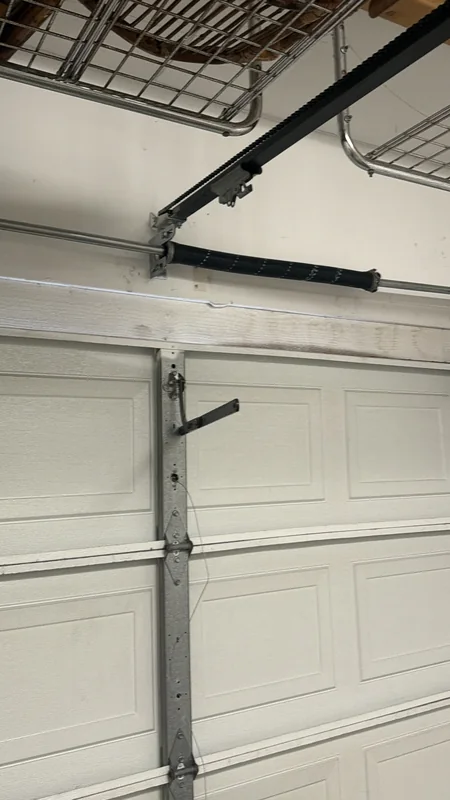
Wear also builds at the drum. When a cable goes slack for a moment, it can hop out of its groove and rub on the drum's edge. That happens when the door lands on something, when a spring weakens, or when a roller catches in a bent track.
Problems that look like a cable but aren't
A crooked door doesn't always mean a cable. On a two-spring door, one broken spring can make the door lift unevenly. A roller out of its track will cock the door too. We sort that out on site, but it helps to mention on the phone whether you can see a gap in a spring or a roller outside the track. The spring page and the off-track page describe those.
Keep your distance
Do not rehook, rewind or tighten a cable, and do not loosen a bottom bracket. The cable ties directly into the spring system, and the bracket takes the springs' full pull. Removing the wrong bolt can release all of it at once.
- Unplug the opener so nobody sets the door moving by accident.
- If the door is partly open, leave it there. Don't use the emergency release.
- Park outside and keep children and pets away from the opening.
- From a safe spot, photograph both bottom corners and both top corners.
How the repair gets done
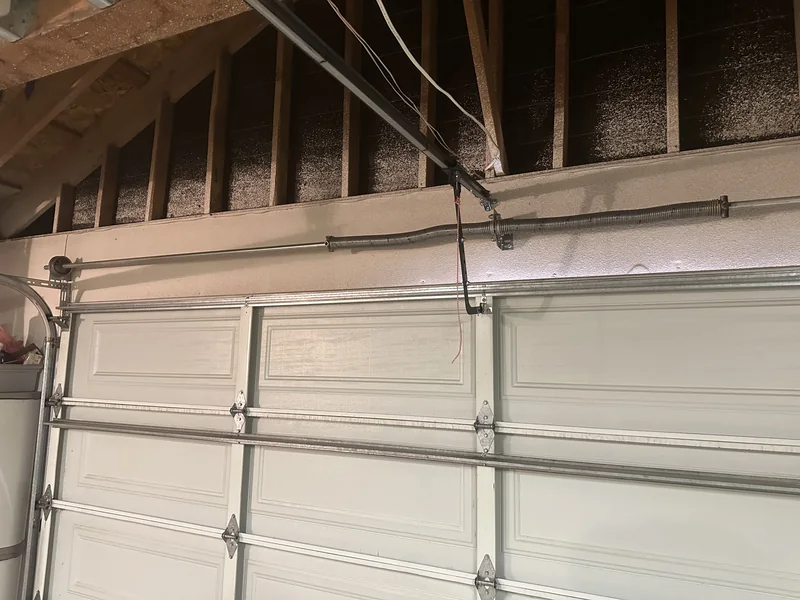
Step one is locking the door in place with clamps on the track so it can't shift. Step two is taking the tension off the springs, which is the only safe way to work on cables. From there we inspect what the failure left behind: the drums, the bottom brackets, the rollers and track on the low side, and the hinges on any section that twisted.
New cables go on as a matched pair, since the old one on the other side has the same age and the same exposure to salt. After the springs are tensioned again, we level the door, confirm both cables wrap evenly, check balance by hand and run the opener's safety reverse.
When a bracket has rusted badly, we recommend replacing it along with the cables. A new cable on a corroded bracket just moves the weak point a few inches.
What to do now
Phone (330) 947-4591 any time of day. If the door is closed and stable, the request form on this page works too. Tell us which side dropped and whether the door is open or shut, and send those corner photos if you took them.